
By David Akinadewo-Adekahunsi
The Independent National Electoral Commission (INEC) and security agencies have largely passed the test of adequate preparation for the 2027 general elections, Yiaga Africa has said in its final assessment of the 2026 Osun State governorship election.
The civil society organisation, which deployed its Watching the Vote (WTV) election observation methodology across the state, said the conduct of the August 15 governorship election provided important evidence that Nigeria’s electoral institutions could deliver credible elections when properly resourced, closely monitored and supported by citizens.
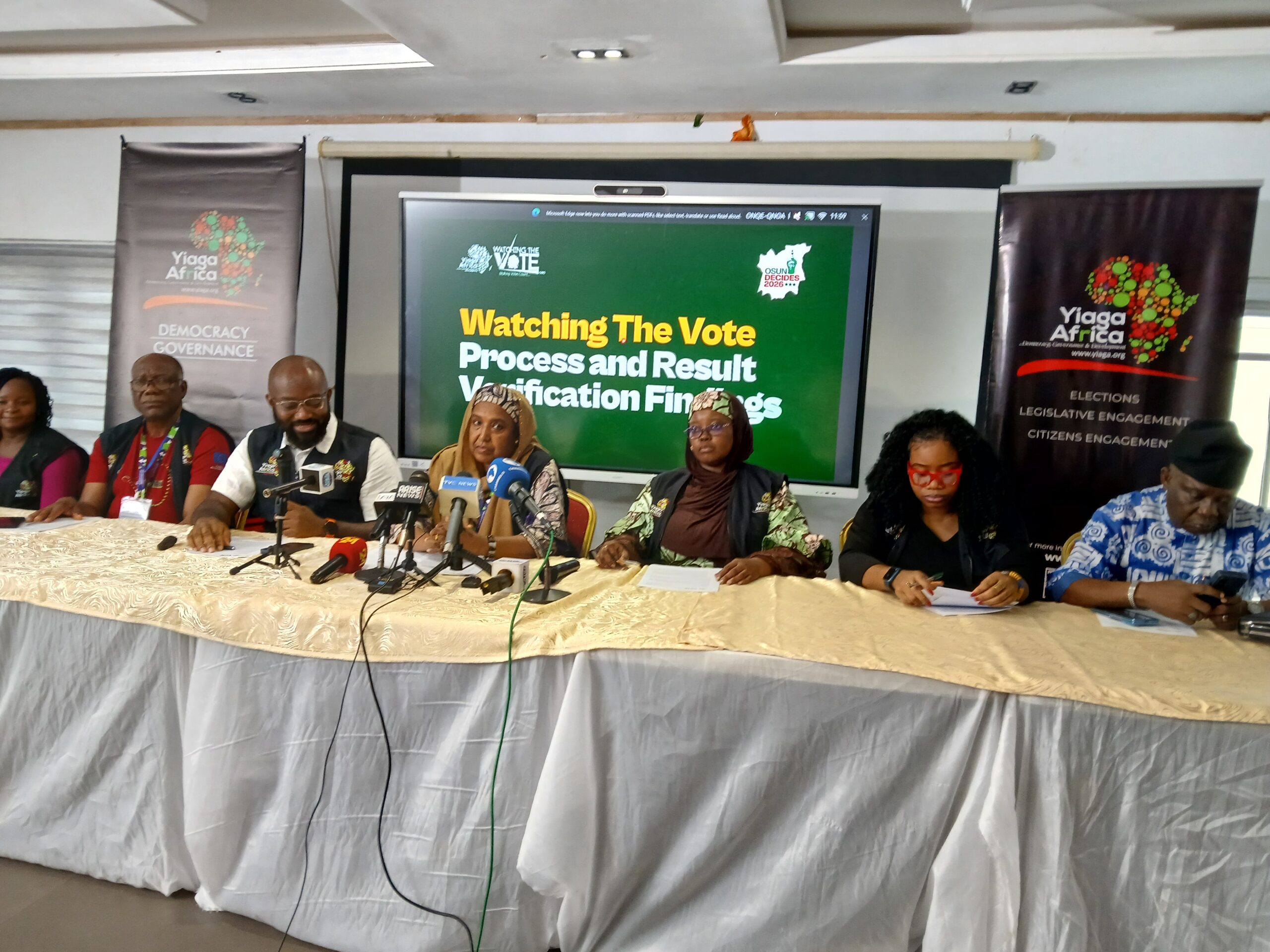
Presenting its Process and Results Verification Statement on the 2026 Osun Governorship Election on Sunday in Osogbo, Yiaga Africa said its assessment was based on reports from 289 of the 300 sampled polling units, representing 96 per cent of its sample, as well as observations from all 30 local government areas and the state and local government collation centres.
The organisation deployed 300 process observers and 32 mobile observers across the state, with the deployment designed to provide timely information on election-day procedures, voter accreditation, voting, counting and the independent verification of official results announced by INEC.
The final assessment was signed by Dr Asmau Maikudi, Chair, 2026 Osun Election Observation Mission, and Samson Itodo, Executive Director, Yiaga Africa.
Yiaga Africa described the election as a defining test of electoral preparedness, security neutrality and public trust, particularly because it was the last major governorship election before the 2027 general elections and one of the earliest significant tests of the Electoral Act 2026 and the new regulatory framework for election administration and results management.
According to the organisation, INEC’s election-day logistics represented one of the clearest improvements recorded during the exercise.
It said that despite the disruption caused by the last-minute court-ordered inclusion of the Social Democratic Party, which required the commission to reprint ballot papers and result sheets only days before the election, INEC largely succeeded in deploying personnel and materials to polling units on time.
By 8:30 a.m., Yiaga Africa said, 48 per cent of the polling units it observed had commenced accreditation and voting. The figure increased significantly to 96 per cent by 9:30 a.m.
The organisation noted that the performance compared favourably with its observation during the 2022 Osun governorship election, when accreditation and voting had commenced in only 41 per cent of polling units by 8:30 a.m., although the figure also reached 96 per cent by 9:30 a.m.
On the deployment of electoral technology, Yiaga Africa said the Bimodal Voter Accreditation System (BVAS) performed satisfactorily in the majority of polling units observed.
It reported that BVAS functioned properly in 80 per cent of the polling units, while malfunction was recorded in 20 per cent. The organisation, however, said the affected devices were subsequently fixed.
The technology-related challenges, it added, did not occur on a scale capable of undermining the election, despite concerns raised during the mock accreditation exercise.
Yiaga Africa said the experience nevertheless underscored the need for INEC to undertake a comprehensive post-election technical audit of BVAS devices, identify the causes of failures and strengthen testing, maintenance and rapid technical support ahead of the 2027 elections.
It also urged INEC to publish the causes of biometric authentication failures recorded during accreditation and indicate the remedial measures to be implemented before the general elections.
On the integrity of the results, Yiaga Africa said its independent verification broadly matched the official figures released by INEC.
Its verification showed that the official results for the three leading political parties fell within its estimated ranges. Accord, which produced Governor Ademola Adeleke, secured 51.9 per cent in the official result against Yiaga Africa’s estimate of 52.1 per cent. The ADC recorded 1.7 per cent in both the official result and Yiaga Africa’s estimate, while the APC secured 45.2 per cent against Yiaga Africa’s estimate of 44.9 per cent.
The organisation said the results demonstrated that the official figures reflected the ballots counted at polling units.
It, however, drew attention to reports of vote-buying and voter inducement, warning that although the consistency between its estimates and INEC’s results spoke to the accuracy of the tabulation of polling-unit results, questions about the integrity of voters’ choices remained.
“Had the results been significantly altered at the ward, LGA, or state collation centres, the official figures would have fallen outside Yiaga Africa’s WTV estimated ranges,” the organisation said.
On voter turnout, Yiaga Africa estimated participation at between 42.5 and 44.8 per cent, while INEC announced an official turnout of 43 per cent at the State Collation Centre.
The organisation said the official figure therefore fell within its confidence interval.
It described the 43 per cent turnout as commendable, particularly against the backdrop of apprehension that preceded the election.
According to Yiaga Africa, the election came after an atmosphere shaped by attacks on Permanent Voter Card collection centres, politically linked violence, confrontations over motor parks and weeks of inflammatory rhetoric.
Despite the tension, it said, citizens came out to vote.
The organisation described the resilience of Osun voters as one of the quiet achievements of the election, stressing that the turnout was not simply a story of apathy but of citizens who refused to be intimidated out of the electoral process.
It further noted that voters went beyond casting their ballots by remaining at polling units to witness sorting, counting and announcement of results, with some following the results to ward and local government collation centres.
Yiaga Africa said such citizen vigilance was an effective deterrent to result manipulation, although it stressed that citizens should not have to “stand guard over an institution’s integrity,” placing the responsibility firmly on INEC and security agencies.
On the electronic transmission and publication of results, the organisation described the IReV platform as a “game changer” in Nigeria’s election results management.
It said the electronic transmission and publication of polling-unit results strengthened transparency, provided an additional safeguard against manipulation and enabled citizens to independently scrutinise the results process.
However, Yiaga Africa expressed concern over the prolonged interruption in the uploading of results on IReV on election night.
It said uploads stalled at 3,292 polling-unit results between 8:48 p.m. and 10:00 p.m., leaving 471 results outstanding, before transmission resumed at approximately 11:50 p.m.
The organisation said the prolonged interruption required a clear explanation from INEC, stressing that sustaining public confidence in IReV required not only timely and complete uploads but also proactive communication whenever technological or operational failures occurred.
On security, Yiaga Africa said security agencies largely demonstrated restraint during the election, describing their generally professional conduct on election day as worthy of acknowledgement.
The organisation said the election demonstrated that robust security deployment did not necessarily have to translate into excessive interference in the electoral process.
It, however, stressed that the standard of neutrality must be sustained across elections, regardless of which political party controls the state or federal government.
Yiaga Africa also called for stronger enforcement against vote-buying, intimidation and electoral violence.
It specifically recommended that security agencies, the Economic and Financial Crimes Commission (EFCC) and the Independent Corrupt Practices and Other Related Offences Commission (ICPC) should extend their enforcement operations beyond polling units to surrounding areas where inducement increasingly takes place.
The agencies, it said, should arrest and prosecute offenders, including party financiers and agents involved in electoral inducement.
The organisation also called on the Nigeria Police Force to publish a report on its deployment during the Osun election, including the number of arrests made and the progress of prosecutions arising from violence recorded during the pre-election period.
Yiaga Africa said it documented a number of critical incidents during the election.
At Polling Unit 4, Ada II, Ward 8, Boripe Local Government Area, voters were reportedly showing party representatives how they had marked their ballot papers.
At another polling unit in Boripe, Polling Unit 5, Ward 11, clashes reportedly occurred between supporters of Accord and the APC, prompting the intervention of police officers who escorted the INEC official and ballot box safely away from the polling unit.
At Polling Unit 16, Ward 3, also in Boripe, three unidentified men reportedly arrived and began taking photographs of polling materials. Their actions allegedly agitated voters, who confronted and assaulted them, resulting in a general fight at the polling unit. The men were later identified as foreign observers, although the name of their observer group was not captured.
In Osogbo Local Government Area, Ward 10, Polling Unit 1, the voter register was initially mixed up with materials intended for another polling unit. INEC was contacted and the problem was resolved. The placement of an ink pad inside the voting cubicle also delayed accreditation, with voting eventually commencing after 11:00 a.m.
Despite the challenges, Yiaga Africa concluded that the people of Osun had demonstrated resilience and commitment to democracy.
Looking ahead to 2027, the organisation said the key challenge for INEC was to convert the lessons from Osun into institutional standards capable of being reproduced across the country’s 176,000 polling units and 36 states.
It urged the commission to strengthen quality assurance for sensitive election materials, resolve inconsistencies in voter data, standardise the implementation of downloadable Permanent Voter Cards and other provisions of the Electoral Act 2026, improve the resilience and transparency of IReV and institutionalise prompt public communication whenever technological or operational failures occur.
For security agencies, Yiaga Africa said the priority should be to sustain neutrality while significantly strengthening enforcement against vote-buying, intimidation and electoral violence.
Among its recommendations, the organisation urged INEC to issue binding and uniform guidance to presiding officers on the acceptance and use of downloadable PVCs for voter accreditation.
It also called for comprehensive training of ad hoc officials, effective oversight of personnel deployed in the field and consistency in the application of election-day procedures.
The organisation further recommended that security agencies review their deployment ahead of the 2027 general elections and ensure the joint deployment of security officials with polling officials and election materials from Registration Area Centres to polling units.
Political parties, Yiaga Africa said, should deepen their commitment to democratic values by investing in systematic training of polling agents on the Electoral Act 2026, INEC regulations and guidelines, as well as voter education ahead of 2027.
The organisation said its observations would form part of a broader report as it begins its national deployment for the 2027 general elections.
Yiaga Africa said the Osun election had demonstrated that Nigeria could conduct credible elections when technology, citizens and institutions worked together, but stressed that the gains must be consolidated before the 2027 general elections.
“The test citizens passed” in Osun, according to the organisation, must now be matched by stronger institutional safeguards so that voters are not required to defend the integrity of elections on their own.