
By Christian Abolu
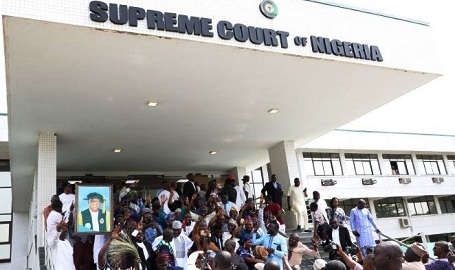
Nigeria’s political landscape witnessed a major judicial intervention on Thursday as the Supreme Court of Nigeria delivered decisive rulings affecting both the Peoples Democratic Party (PDP) and the African Democratic Congress (ADC), reinforcing the primacy of due process in party affairs.
In one of the rulings, the apex court voided the national convention conducted by the Peoples Democratic Party in Ibadan, Oyo State, on November 15 and 16, 2025.
In a split decision of three to two, the court held that the convention, which produced a national executive led by the Turaki faction, was conducted in violation of a valid subsisting court order.
Delivering the lead judgment, Justice Stephen Adah ruled that the appellants acted unlawfully by proceeding with the exercise despite an earlier injunction issued by the Federal High Court.
The apex court upheld prior rulings nullifying the convention, affirming that the PDP disregarded judicial authority when it went ahead with the exercise.
Justice Peter Lifu had, before the convention, restrained the party from conducting the exercise pending the inclusion of former Jigawa State Governor, Sule Lamido, in the process.
Despite the order, the PDP proceeded with the convention, arguing that the matter was an internal party affair beyond the jurisdiction of the courts, a position the Supreme Court firmly rejected.
In a separate but equally significant judgment, the apex court unanimously set aside a “status quo ante bellum” order earlier issued by the Court of Appeal in the leadership dispute within the African Democratic Congress.
The five-member panel, led by Justice Mohammed Lawal Garba, described the appellate court’s directive as “unnecessary, unwarranted and improper,” noting that it exceeded the bounds of interlocutory intervention.
The disputed order, issued on March 12, 2026, had directed parties to maintain the status quo pending determination of the case.
However, it created a leadership vacuum within the ADC, culminating in the decision of the Independent National Electoral Commission to delist the executive aligned with David Mark from its official records.
The apex court held that such preservatory orders must not override substantive adjudication of rights, stressing that internal party disputes should be resolved through full trial proceedings rather than interim directives.
It consequently ordered all parties to return to the Federal High Court for an accelerated hearing of the substantive suit filed by Nafiu Bala Gombe.
While the ruling effectively removes the legal basis for INEC’s earlier action and may prompt a review of the delisting, the court refrained from making any pronouncement on the legitimacy of either faction’s leadership.
The decision is, however, seen as a procedural victory for the faction associated with David Mark and former Osun State Governor, Rauf Aregbesola.
Implications for Party Politics
The twin rulings underscore the judiciary’s growing role in shaping internal party dynamics and enforcing compliance with the rule of law.
For the PDP, the judgment deepens its internal crisis, nullifying a key convention and raising fresh questions about the legitimacy of its leadership structure.
In the ADC, although the immediate leadership freeze has been lifted, the battle for control remains unresolved, with the focus now shifting to the Federal High Court for a substantive determination.
Observers note that both decisions could have far-reaching implications as political parties begin early alignments ahead of the 2027 general elections, particularly in reinforcing judicial oversight over party processes and internal governance.