
By David Akinadewo-Adekahunsi
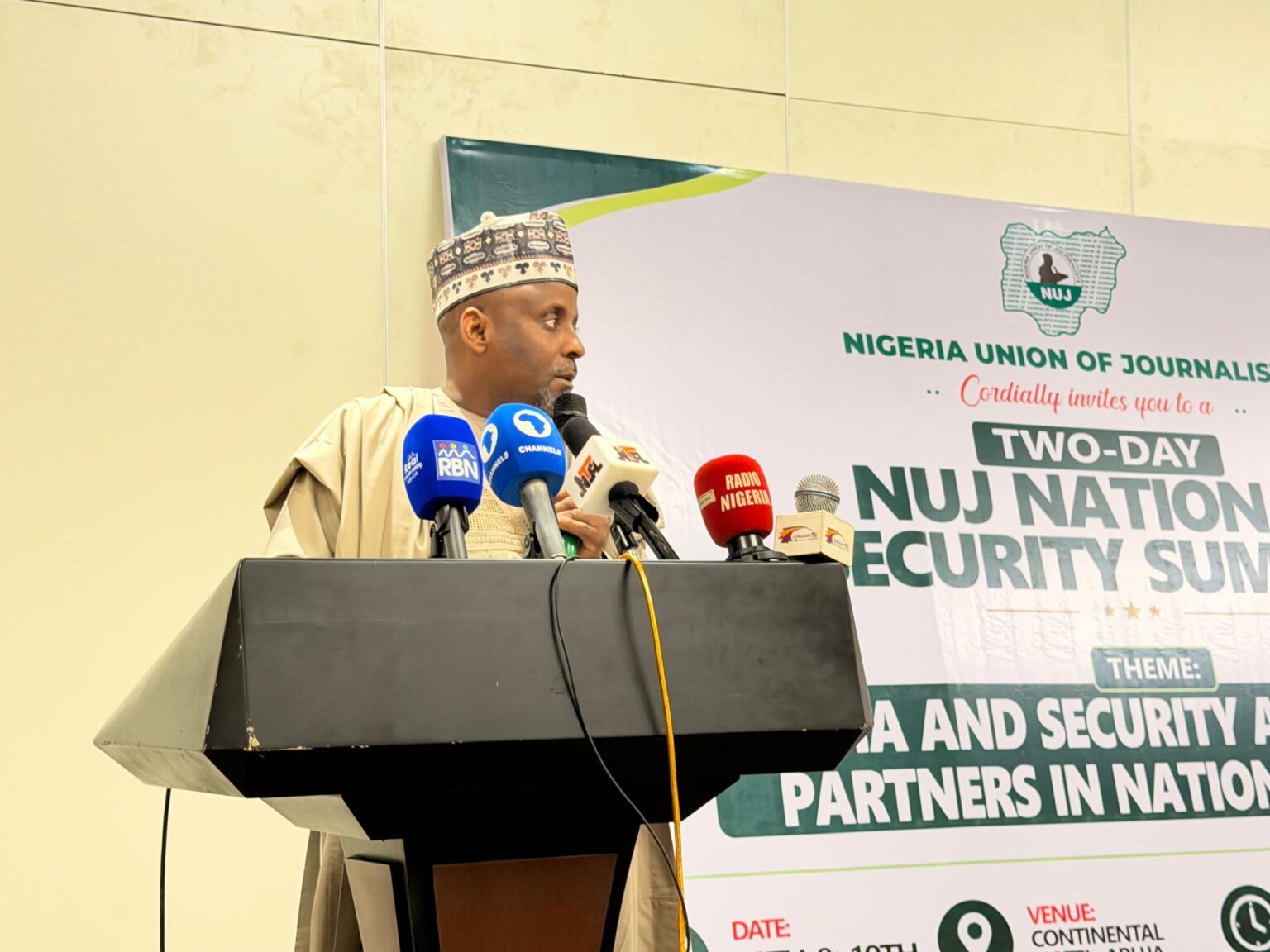
Participants at the Nigeria Union of Journalists (NUJ) National Security Summit have called for stronger collaboration between the media and security agencies as part of efforts to address Nigeria’s growing security challenges and promote national development.
The two-day summit, organised by the NUJ in collaboration with the Department of State Services (DSS), ended in Abuja on Friday with a communiqué outlining key observations and recommendations aimed at strengthening national security through strategic partnerships.
The summit, themed “Media and Security Agencies as Partners in Nation Building,” brought together media executives, journalists, heads of security and intelligence agencies, government officials, policymakers, academics, civil society groups, women organisations and development partners.
In his welcome address, NUJ National President, Comrade Alhassan Yahaya Abdullahi, described the summit as a timely response to the country’s security challenges, including terrorism, banditry, kidnapping, cybercrime, violent extremism, communal conflicts and the growing threat of misinformation and disinformation.
According to him, national security remains a collective responsibility that requires coordinated action among all stakeholders, while responsible journalism remains critical to promoting national unity, accountability and stability.
The Minister of Information and National Orientation, Mohammed Idris, who chaired the event, highlighted the complementary roles of the media and security agencies in nation-building.
He noted that while security agencies are responsible for safeguarding lives, property and national sovereignty, the media serves as a watchdog and a bridge between government and citizens.
The minister advocated stronger trust, professionalism and strategic communication between both institutions and reaffirmed the Federal Government’s commitment to intelligence-driven security operations, technological innovation and community-based approaches to combating insecurity.
Delivering a keynote presentation titled “The Media as an Impact Multiplier in Military Operations and National Development,” Professor Okey Ikechukwu described the media as a force multiplier capable of enhancing security operations through effective communication and public engagement.
He stressed that communication gaps often create opportunities for harmful narratives and misinformation, making strategic communication an essential component of modern security management.
Also speaking, President of the International Press Institute (IPI) Nigeria, Musikilu Mojeed, examined the relationship between national security and press freedom, arguing that both are mutually reinforcing pillars of democracy.
Mojeed maintained that disagreements between the media and security agencies should be resolved through dialogue, professional accountability and due process rather than intimidation or coercion.
The President of the Nigeria Association of Women Journalists (NAWOJ), Aisha Ibrahim, underscored the role of women in peacebuilding, conflict prevention and social cohesion, calling for greater inclusion of women in security governance and decision-making processes.
One of the major highlights of the summit was the investiture of the Director-General of the Department of State Services, Mr. Adeola Oluwatosin Ajayi, in recognition of his efforts in promoting constructive engagement between the media and security institutions.
Participants observed that Nigeria continues to face complex and multidimensional security threats and agreed that sustainable solutions require a whole-of-society approach involving security agencies, the media, government institutions and citizens.
The summit noted that misinformation and disinformation remain significant threats to public trust and social cohesion, while unemployment, poverty and drug abuse continue to fuel insecurity across the country.
At the end of deliberations, participants resolved that structured mechanisms for regular engagement between media organisations and security agencies should be institutionalised.
They also recommended improved communication strategies by security agencies, stronger ethical standards and fact-checking by media organisations, joint capacity-building programmes for journalists and security communication officers, increased investment in education and youth empowerment, and greater involvement of women in peacebuilding and security governance.
The summit further urged governments at all levels to strengthen support for state-owned media organisations, improve funding for security agencies and formalise community-based security and early warning systems.
Participants expressed appreciation to the DSS leadership for its partnership in organising the summit and reaffirmed that national security is a shared responsibility requiring trust, transparency, accountability and collaboration among all stakeholders.
The communiqué was signed by Comrade Alhassan Yahaya Abdullahi, National President of the NUJ, on behalf of participants at the summit.