

By Our Reporter
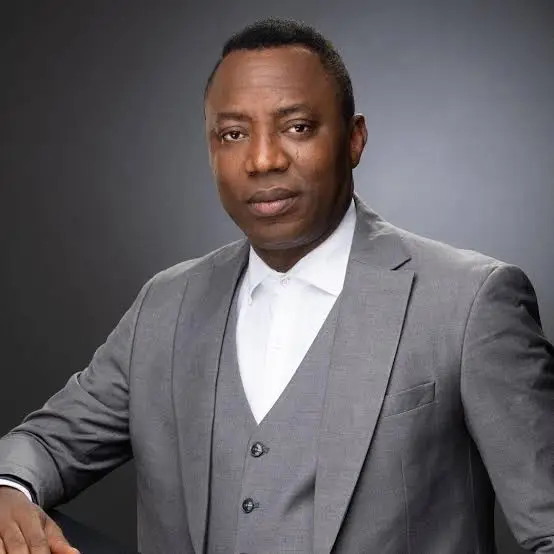
The presidential candidate of the African Action Congress (AAC), Omoyele Sowore, has promised to introduce a monthly living minimum wage of N500,000 for Nigerian workers if elected president in the 2027 general elections.
Sowore, an activist and publisher of Sahara Reporters, also pledged to provide 24-hour electricity, make education free and accessible at all levels, construct one million public mixed-income houses and reform tenancy laws to end the burden of advance rent payments on working Nigerians.
He made the promises in an interview with Independent, published on Sunday, while outlining the AAC’s policy agenda for the 2027 presidential election.
Sowore said the party’s programme was anchored on what he described as “revolutionary justice and equal rights”, arguing that Nigeria’s abundant natural resources had not translated into improved living conditions for the majority of its citizens because of corruption, incompetence and an economic system that favoured a small political and business elite.
He said the proposed N500,000 monthly living minimum wage was necessary because the existing income levels of Nigerian workers could no longer adequately meet the rising cost of living.
“We are proposing a ₦500,000 monthly living minimum wage because Nigerian workers cannot continue receiving starvation wages while senators, governors and political appointees consume millions every month,” he said.
The AAC candidate also promised to tackle Nigeria’s electricity crisis by providing 24-hour power, arguing that no serious industrial economy could continue to depend heavily on generators.
He further pledged free and accessible education at all levels, insisting that poverty should not prevent Nigerian children from acquiring education.
“No Nigerian child should be denied education because his or her parents are poor,” he said.
On housing, Sowore promised that an AAC administration would construct one million public mixed-income homes while reforming tenancy laws to reduce the pressure created by the widespread practice of demanding one or two years’ rent in advance.
He also promised to overhaul the healthcare system, saying access to medical care should be treated as a right rather than a privilege for Nigerians who could afford to travel abroad for treatment.
“We will industrialise Nigeria, massively expand agricultural production and processing, rebuild infrastructure and create dignified employment,” he said.
On security, Sowore pledged to reform the nation’s policing and security architecture, improve the welfare and compensation of security personnel and deploy modern technology, including drones and advanced intelligence systems, in the fight against insecurity.
He also promised what he described as an “uncompromising war” against corruption, including the recovery of public resources allegedly stolen by political officeholders.
According to him, Nigeria’s wealth must be deployed for the benefit of Nigerians rather than concentrated in the hands of a few politically connected individuals.
Sowore, who is one of the 18 presidential candidates formally announced by the Independent National Electoral Commission on Saturday, said the AAC would finance its 2027 campaign through a “people-funded campaign” rather than depend on wealthy individuals and political patrons.
He said the party’s independence from political godfathers, governors and wealthy financiers remained one of its major strengths as it prepared for the election.
The AAC candidate also reiterated his advocacy for a leftist political alternative, saying Nigerians were “more ready than ever” for a government based on socialist principles.
He argued that decades of capitalist governments had produced enormous wealth for a small section of society while leaving millions of Nigerians trapped in poverty and inequality.
Sowore explained that the AAC’s socialism would focus on ensuring that the wealth produced by society improved the lives of the people who created it.
“Our socialism is practical. It means the wealth produced by society must improve the lives of the people who produce it. It means universal education, healthcare, decent housing, electricity, living wages and social protection,” he said.
He added that workers deserved dignity and that Nigeria’s natural resources should belong to the Nigerian people rather than a small group of politically connected billionaires.
The activist also criticised the economic policies of President Bola Ahmed Tinubu’s administration, saying an AAC government would reverse what he described as the philosophy underpinning the current policies.
He said his administration would assess economic policies primarily by their impact on the material conditions and welfare of ordinary Nigerians.
On the security challenges that could affect political campaigns ahead of the 2027 elections, Sowore said he would demand professionalism from security agencies while insisting on his constitutional rights.
He maintained that security agencies were accountable to the Nigerian people and should not operate as private security outfits for political officeholders or political parties.
“I have never asked Nigeria’s security agencies for favours. I demand professionalism. Police officers, soldiers and intelligence personnel are employees of the Nigerian people. They are not private security guards belonging to a president, governor, minister or ruling political party,” he said.
Sowore, who has been arrested, detained, prosecuted and attacked under different administrations, said his past experiences had not weakened his resolve to challenge the political establishment.
He said his proposed administration would improve the welfare of security personnel and professionalise the country’s security institutions.
Sowore emerged as the AAC presidential candidate for the 2027 election after being selected by consensus.
Although he recorded relatively low votes in his 2019 and 2023 presidential bids, the activist expressed confidence in the party’s prospects in 2027, saying its chances had “never been better”.
He attributed the optimism to what he described as the AAC’s continued independence from political godfathers, state governors and wealthy patrons.