

• IPC deploys AI-powered WhatsApp platform to protect journalists during election
By David Akinadewo-Adekahunsi
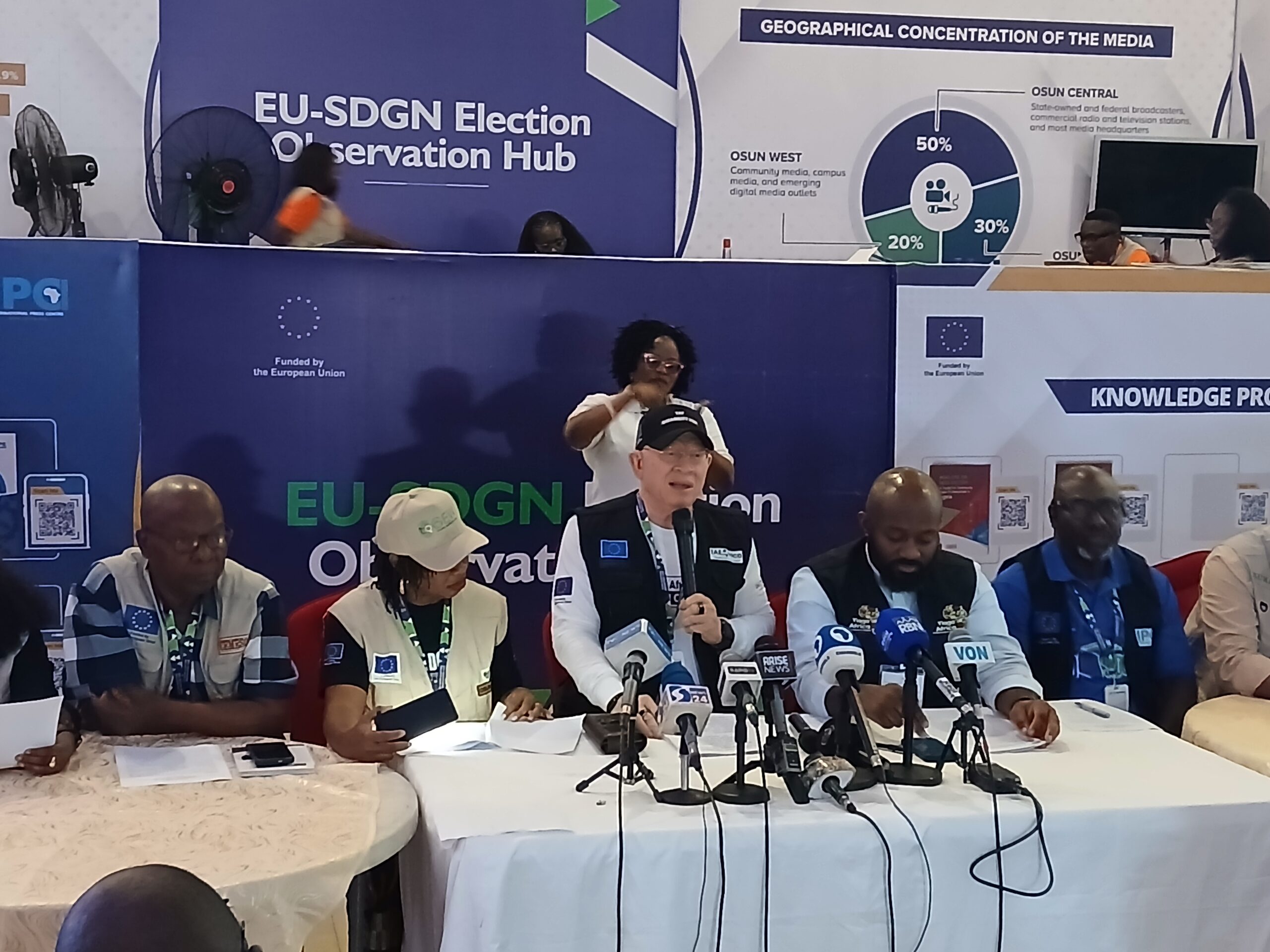
The European Union Support to Democratic Governance in Nigeria Election Observation Hub (EU-SDGN EOH) has urged the Independent National Electoral Commission (INEC) to ensure the transparent and timely announcement of results at every stage of Saturday’s Osun State governorship election, while calling on political parties and candidates to respect the July 30 Peace Accord and accept the outcome declared by the electoral commission.
The observation hub made the demand in its pre-election statement issued on Friday ahead of the August 15 governorship poll, stressing that the credibility of the election would depend not only on voting but also on a transparent and verifiable process of collation and declaration.
The EU-SDGN EOH specifically called on INEC to ensure the timely announcement of results from polling units through Registration Areas and Local Government Areas to the State Collation Centre.
It also urged political parties and candidates to respect the sanctity of the Peace Accord by accepting the outcome declared by INEC and pursuing grievances through lawful and judicial channels rather than resorting to protests, violence or self-help.
The observers said the recommendations were necessary against the backdrop of a highly competitive and tense political environment in Osun, characterised by intense political rivalry, an unresolved dispute over control of some local government secretariats, security concerns and the circulation of fake news, misinformation and disinformation.
The Hub said INEC had declared itself operationally, technologically and logistically ready for the election, with about 17,500 ad-hoc personnel recruited, trained and deployed.
It noted that 97 Super Registration Area Centres and 105 Registration Area Centres had been activated to facilitate the deployment of personnel and support the timely opening of the state’s 3,763 polling units.
However, the observers raised concerns about the electronic transmission and collation of results, particularly the process through which polling-unit results transmitted to the INEC Result Viewing Portal (IReV) undergo backend validation before publication.
They called on INEC to publish a clear protocol explaining the entire results-transmission process, including the purpose of the electronic EC8A, the backend validation process and which version of a result would prevail where discrepancies arise.
The Hub also urged the commission to publish Ward and Local Government collation result sheets alongside polling-unit results on IReV to enable citizens, political parties and observers to independently verify the results at every stage of collation.
It identified vote-buying and voter inducement as the highest threats to the credibility of the election, while also warning about the potential impact of misinformation and inflammatory political communication on the electoral process.
The observers said INEC had indicated that plain-clothes financial intelligence officers, working with the Economic and Financial Crimes Commission and the Independent Corrupt Practices and Other Related Offences Commission, would be deployed around polling units to deter and prosecute vote trading.
The Hub further urged the media and civil society organisations to intensify conflict-sensitive reporting and real-time fact-checking to prevent the escalation of political tensions.
Meanwhile, as part of efforts to safeguard journalists covering the election, the International Press Centre (IPC) has deployed the WAFLО WhatsApp-enabled Live Election Incident Reporting System, an artificial intelligence-assisted platform designed to facilitate real-time reporting, documentation and monitoring of incidents affecting journalists and press freedom during the poll.
The IPC said the deployment was a pilot scheme intended to enable journalists and other media professionals to promptly report assaults, threats, intimidation and other infringements on press freedom during the election.

According to the centre, WAFLО would subsequently be upgraded and expanded for full deployment during the 2027 general elections.
The platform is designed to turn reported incidents into actionable information, allowing relevant stakeholders to identify threats, verify reports and respond more quickly to attacks or other safety concerns affecting journalists.
The initiative forms part of Component 4 of the European Union Support to Democratic Governance in Nigeria Phase Two programme, being implemented by the IPC and the Centre for Media and Society (CEMESO), in collaboration with key stakeholders, including the Nigeria Union of Journalists.
The IPC said the conditions under which journalists are allowed to carry out their duties were a direct measure of society’s commitment to civic and democratic values.
It therefore advised journalists covering the Osun election to ensure they were properly accredited and carried their identification cards, press/media tags and other relevant credentials at all times to minimise unnecessary questioning, identity checks and possible obstruction by security personnel.
The centre also called on security agencies, political actors, election stakeholders and other relevant authorities to respect journalists’ rights to perform their constitutional and professional responsibilities without intimidation, harassment or undue interference.
Journalists can report incidents through the SafeMedia WhatsApp channel by typing “safemedia” to the designated WhatsApp number provided by the IPC or through its SafeMedia prompt.
The IPC further encouraged journalists to make use of its safety desk and existing emergency hotlines while adhering to safety guidelines throughout the election.