
By Duchess Ifeoluwa
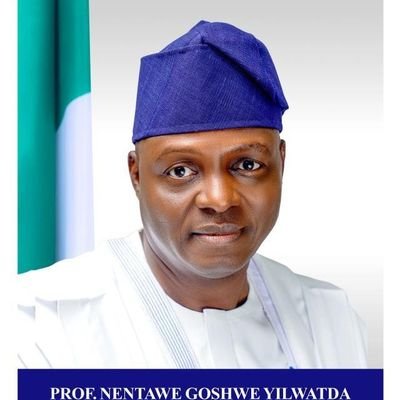
The National Chairman of the All Progressives Congress (APC), Prof. Nentawe Goshwe Yilwatda, has said President Bola Ahmed Tinubu’s administration is making strategic investments in infrastructure and human capital development to position Nigeria as a one-trillion-dollar economy.
Yilwatda stated this while receiving the Governing Council of the Federal University of Health Sciences, Otukpo, Benue State, led by its Pro-Chancellor, Prof. Muhammad Audu, at the APC National Secretariat in Abuja.
In a statement issued by his Special Adviser on Media and Information Strategy, Abimbola Tooki, the APC chairman said the Federal Government’s investments in roads, bridges, rail transport, deep seaports, education and other critical infrastructure were aimed at boosting productivity, attracting investment, creating jobs and driving sustainable economic growth.
According to him, the Tinubu administration recognises that efficient transportation networks and modern infrastructure are essential for long-term economic development.
He disclosed that the Federal Government is pursuing the establishment of five major deep seaports across the country, including the Badagry Deep Sea Port in Lagos State, Olokola Deep Sea Port on the Ondo-Ogun coastal axis, Ibom Deep Sea Port in Akwa Ibom State, Bakassi Deep Sea Port in Cross River State and Bonny Deep Sea Port in Rivers State.
“These are not isolated infrastructure projects. They are part of a larger economic strategy. We are building the infrastructure that will support the one-trillion-dollar economy that President Bola Ahmed Tinubu has set as a target for Nigeria,” Yilwatda said.
He added that the Federal Government is also constructing seven coastal highways to link the proposed seaports and improve the movement of people, goods and services nationwide.
The APC chairman also defended the railway project linking Nigeria with Maradi in the Republic of Niger, describing it as a strategic initiative that would strengthen regional trade and improve Nigeria’s competitiveness as a logistics and commercial hub.
He explained that the rail line would facilitate the movement of goods from the landlocked Niger Republic through Nigerian seaports, thereby increasing trade volumes and economic activities.
Yilwatda disclosed that the Federal Government is executing 81 road projects across the North-Central zone and over 260 road and bridge projects nationwide.
He added that 27 major road projects worth about ₦3.9 trillion had recently been approved across 15 states to improve connectivity, reduce travel time and stimulate commerce.
“Our objective is to improve connectivity across the country so that Nigerians can travel from one part of the country to another within a reasonable period. Better roads mean better commerce, easier access to markets, improved access to healthcare and education, and greater opportunities for investment,” he said.
Speaking on the administration’s economic reforms, Yilwatda said the new tax policies were designed to promote fairness by reducing the burden on low-income earners while ensuring higher-income individuals contribute proportionately more.
He also said the Federal Government’s foreign exchange reforms had improved market stability by addressing distortions associated with the parallel market.
According to him, Nigeria’s economy is showing positive signs, citing about four per cent Gross Domestic Product (GDP) growth and increased investor confidence.
He further revealed that the country had secured major investment commitments, including a reported $20 billion investment by Shell, which he said would create employment opportunities and stimulate economic growth.
Yilwatda stressed that the administration’s economic reforms are being complemented by sustained investments in education and healthcare, describing both sectors as critical to Nigeria’s human capital development.
He commended the Federal University of Health Sciences, Otukpo, for its role in producing skilled healthcare professionals and described the institution as a strategic investment in the country’s future.
The APC chairman also welcomed the Federal Government’s recent measures to improve the welfare of university lecturers, expressing optimism that better remuneration and improved working conditions would strengthen the education sector and minimise industrial disputes.
Earlier, the Pro-Chancellor of the Federal University of Health Sciences, Otukpo, Prof. Muhammad Audu, appealed to Yilwatda to facilitate a meeting between the university’s Governing Council and President Bola Tinubu, as well as the Minister of the Federal Capital Territory, Nyesom Wike.
According to Audu, the engagement would provide an opportunity for the institution to present its developmental needs and seek support for critical infrastructure projects.
Responding, Yilwatda assured the delegation that the request would receive due attention, noting that the development of tertiary institutions aligns with the Tinubu administration’s commitment to strengthening human capital and expanding access to quality education.