
By David Akinadewo-Adekahunsi
The media occupies a strategic position in every democratic society. Journalists are expected to inform the public, interrogate power, and create a platform for balanced discourse on issues of public interest. Because of this responsibility, the conduct of journalists, particularly during live interviews, must be guided by professionalism, neutrality, and respect.
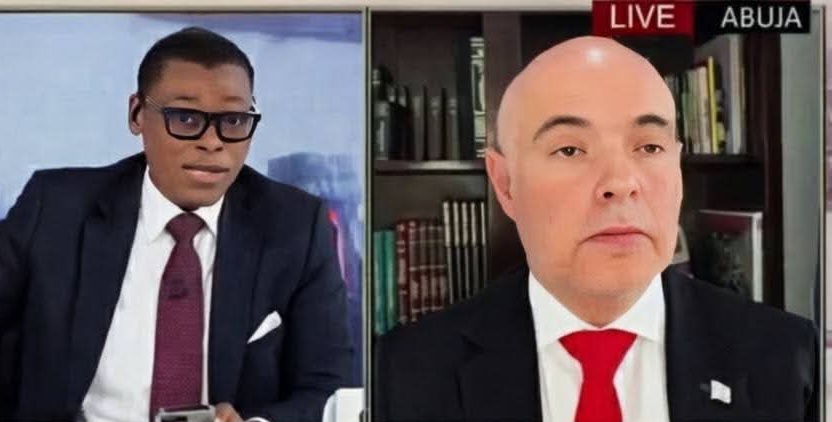
A recent televised interview involving Rufai Oseni, a prominent host on Arise TV, and the Israeli Ambassador to Nigeria, Michael Freeman, has stirred debate within media circles. The interview, which was expected to provide viewers with insights into a sensitive international issue, instead raised concerns about the tone and professionalism displayed during the exchange.
In journalism training across the world, one fundamental principle is emphasised repeatedly: a journalist must remain neutral while conducting interviews. Regardless of personal opinions or ideological inclinations, the interviewer’s duty is to guide the conversation in a manner that allows the guest to respond fully while ensuring that the audience receives clarity on the issues being discussed.
Unfortunately, the tone adopted during the interview appeared overtly combative and judgmental. Rather than maintaining the calm and measured disposition expected of a professional journalist, the conversation took on an adversarial posture. Interruptions became frequent, and the phrase, “Do not interrupt me,” directed at the guest, struck many observers as unnecessarily harsh and bordering on disrespect.
In professional journalism practice, words and tone matter greatly. A journalist can control the direction of an interview without sounding confrontational. Expressions such as “Kindly allow me to land,” or “May I conclude my thought before you respond, please?” convey firmness while maintaining courtesy. These are the subtle but important distinctions that reflect proper newsroom grooming and professional discipline.
It must be clearly stated that asking tough questions is not the problem. Journalism thrives on critical inquiry. Public officials, diplomats, and policymakers must expect probing questions from journalists. However, firmness should not be confused with hostility. A journalist’s strength lies in composure, clarity, and intellectual depth—not in verbal combat.
Having spent three decades in the newsroom, I have learned that the most effective interviewers are not the loudest voices in the room. They are those who listen carefully, ask precise questions, and allow their guests enough space to reveal their positions. Often, it is patience, not aggression, that exposes contradictions and brings out the truth.
The incident also draws attention to a deeper challenge confronting the Nigerian media landscape: the gradual erosion of professional culture in some quarters of the industry. With the increasing politicisation of broadcasting and the influx of individuals who may lack thorough grounding in journalism ethics, the line between professional interviewing and ideological confrontation is becoming blurred.
Journalism is not merely about speaking on television or asking provocative questions. It is a disciplined profession governed by established ethical standards. These standards exist to protect the credibility of the media and to ensure that public discourse remains civil and productive.
Young journalists entering the profession must therefore understand the importance of learning through the ropes. Traditionally, reporters grew within the newsroom system—learning from editors, senior correspondents, and seasoned broadcasters. This apprenticeship culture helped to instill professional values such as restraint, fairness, and respect for opposing viewpoints. When this process is bypassed, the result is often premature confidence without the accompanying professional maturity.
Media proprietors also have an important role to play. News organisations must prioritise the recruitment of well-trained journalists and invest in continuous professional development. Regular training in interviewing techniques, media ethics, and conflict-sensitive reporting is essential for maintaining credibility in an increasingly competitive and politically charged media environment.
Editors and programme directors must equally ensure that their platforms promote respectful engagement, even when discussing controversial global issues. Television interviews today reach audiences far beyond national borders. Consequently, the conduct of journalists reflects not only on the media house but also on the professionalism of Nigerian journalism as a whole.
Nigeria’s media tradition is rich with examples of courageous yet disciplined journalism. From the nationalist press that challenged colonial rule to the brave journalists who resisted military dictatorship, professionalism and intellectual rigour were the defining traits of the profession. That legacy should not be compromised by avoidable lapses in decorum.
Ultimately, the purpose of an interview is illumination, not confrontation. When journalists maintain balance and professionalism, they elevate public discourse and reinforce the trust that society places in the media.
Professionalism remains the journalist’s greatest asset. Without it, the authority of the press begins to erode, and the noble calling of journalism risks being reduced to mere spectacle.
David Akinadewo-Adekahunsi is a Nigerian journalist, author, musician and clergyman with 30 years of experience in print journalism. He is the Managing Director and Editor-in-Chief of Nigerian Monitor Magazine (Online). He is also the founder of the gospel music group Pillar of Bethel Angelic Voices (POBAV), also known as Aremolekun. He writes regularly on media ethics, faith, culture, governance, and social justice.
Email: akinadewodavid@gmail.com
08082870456