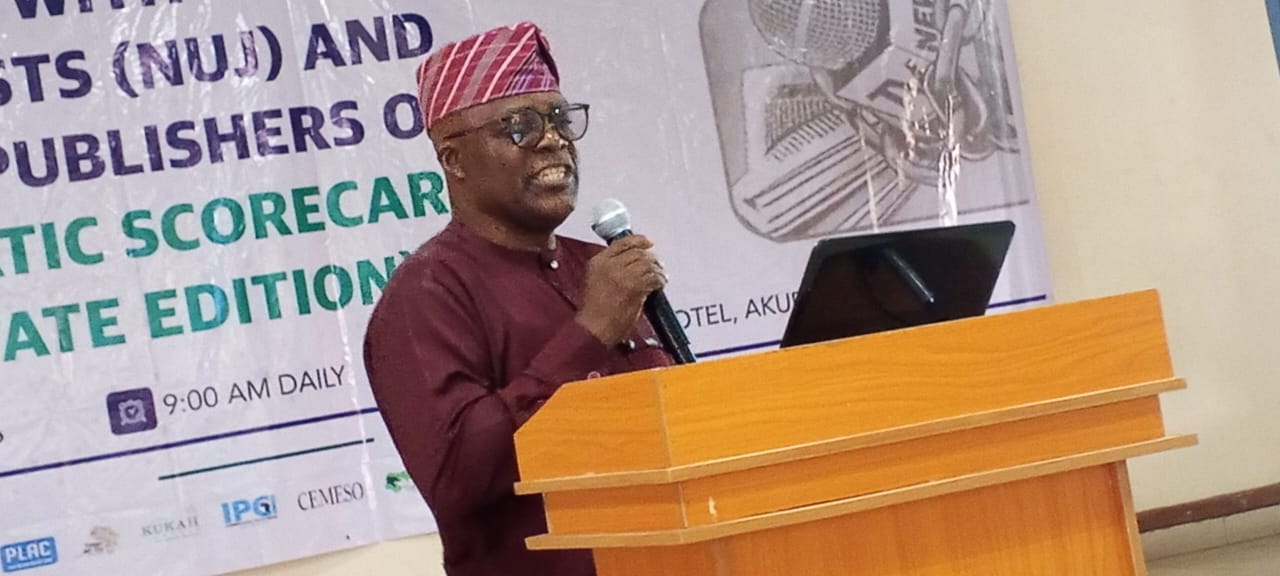


By David Akinadewo-Adekahunsi
When the National Youth Service Corps (NYSC) was established in 1973 by the administration of General Yakubu Gowon, it was conceived as one of the major instruments for healing a nation emerging from the devastating effects of the Nigerian Civil War. The objective was to foster national unity, promote cultural integration and encourage young graduates to appreciate the diversity of Nigeria by serving outside their states of origin.
More than five decades later, the scheme remains one of Nigeria’s most enduring nation-building programmes. Millions of graduates have participated in the initiative, building friendships, marriages and professional networks across ethnic and religious divides.
However, the security realities confronting Nigeria today have fundamentally altered the environment in which the scheme operates. Terrorism, banditry, kidnapping, communal conflicts, violent extremism and election-related violence have turned what was once a patriotic assignment into a dangerous undertaking for many young graduates.
The question confronting the nation today is simple: Can Nigeria continue to sacrifice the lives of its future leaders in the name of national integration?
For many parents, mobilisation for national service is no longer a moment of joy alone. It is increasingly a source of fear and anxiety.
Every year, fathers and mothers watch their children leave home for distant states, uncertain whether they will return safely. Sadly, many have not.
One of the most heartbreaking examples occurred on March 31, 2026, in Plateau State.
Haruna Ibrahim was looking forward to one of the happiest days of his life. Having successfully completed his one-year mandatory national service, he was scheduled to participate in his Passing Out Parade on that very day.
His parents had every reason to celebrate. Their son was about to complete his service to the nation and begin a new chapter of his life.
Instead, they received the devastating news of his death.
Haruna was reportedly attacked and burnt alive during renewed violence in the Anguwan Rukuba area of Jos North Local Government Area of Plateau State. According to eyewitness accounts, he became a victim of a reprisal attack following an earlier assault on the community by unidentified gunmen.
The tragedy was particularly painful because it occurred on the very day he was expected to receive his discharge certificate.
Haruna, who served at Almustafa Private School in Jos and had recently married, became another casualty of Nigeria’s worsening security crisis.
His gruesome murder once again exposed the vulnerability of corps members deployed to volatile regions across the country.
Sadly, Haruna’s death was not the first time the nation would mourn corps members who lost their lives while serving their fatherland.
In November 2013, three corps members — Leke Akande, 23; Tola Odusola, 20; and Ibukun Oluwatosin Akinjogbin, 23 — were killed in Jos during a violent outbreak that followed local government elections in Plateau State.
The young graduates were murdered when hoodlums invaded their residence in the city.
The incident shocked the nation and underscored the dangers corps members face whenever political and communal tensions erupt in their host communities.
Their corpses were later conveyed to their grieving families in Lagos and Ibadan.
The National Emergency Management Agency (NEMA) secured the approval of the Nigerian Air Force to transport their remains home in recognition of their sacrifice and to reduce the burden on their bereaved families.
But no gesture could compensate for the dreams that were buried with them.
Even more tragic was the post-election violence of 2011, during which six NYSC members were brutally murdered in Giade, Bauchi State.
The corps members had committed no offence. They were simply serving their country.
Following the announcement of the presidential election results, violence broke out in parts of northern Nigeria. Seeking safety, the corps members took refuge at the Giade Divisional Police Headquarters.
Ironically, what should have been a place of protection became the scene of unimaginable horror.
According to details later provided by the Bauchi State Police Command, a violent mob led by one Kabiru Musa, popularly known as Dawa, stormed the police station armed with dangerous weapons, including cutlasses, sticks, knives and petrol.
The attackers allegedly killed Police Constable Rifkatu Bappa, set vehicles ablaze and launched a deadly assault on the station.
The wife of a resident, Mrs. Bridget Peter Okoye, reportedly had some of her fingers severed during the attack.
As the station was engulfed in flames, the six corps members attempted to flee for safety.
But the attackers allegedly pursued them, caught up with them and murdered them in cold blood.
For thirteen years, the identities of those responsible remained unresolved until 2024 when the Bauchi State Police Command announced the arrest of Kabiru Musa after a decade-long manhunt.
According to the police, fear within the community had made it difficult to obtain information about the suspect for years.
His eventual arrest came during investigations into another alleged murder case involving the killing of a 17-year-old girl.
The revelation reopened painful memories of one of the darkest chapters in the history of the NYSC scheme.
These tragedies are only a fraction of the dangers corps members have faced over the years.
Many have been kidnapped while travelling to or from their places of assignment. Others have been abducted by bandits operating along major highways and in rural communities.
Some were fortunate enough to regain their freedom after ransom payments. Others disappeared without trace.
Road accidents have also claimed the lives of countless corps members.
Every mobilisation season, thousands of graduates undertake long and exhausting journeys across Nigeria. Young men and women from the South-East are deployed to the North-West. Graduates from the South-West are posted to the North-East. Others travel from the South-South to distant northern states.
These journeys often involve spending several days on dangerous highways plagued by poor road conditions, reckless driving and criminal attacks.
Many never arrive at their destinations.
The time has therefore come for a fundamental review of the NYSC deployment policy.
While the objective of national integration remains commendable, public policy must respond to prevailing realities.
The Nigeria of 1973 is not the Nigeria of today.
A practical solution would be to deploy corps members within their respective geopolitical zones.
An Igbo graduate should be allowed to serve within the South-East. Yoruba graduates should be deployed within the South-West. The same principle can apply to graduates from the South-South, North-Central, North-East and North-West.
Such an arrangement would significantly reduce security risks while preserving the core objectives of national service.
Critics may argue that regional deployment would weaken national integration. But what kind of integration is achieved when parents receive the corpses of children who merely answered the nation’s call?
The preservation of human life must take precedence over every other consideration.
A corps member serving among people who understand his language, culture and environment stands a better chance of finding support and protection during periods of crisis than one serving in a completely unfamiliar setting where he may be viewed as an outsider.
The Federal Government and the National Assembly must urgently revisit the NYSC Act and adapt it to present-day realities.
This is not a call for the abolition of the scheme. Rather, it is a call for reform in the interest of national survival.
If the current situation persists, many parents may begin to question the wisdom of allowing their children to participate in mandatory national service. Some may even resist mobilisation altogether.
Nigeria is bleeding.
From terrorism and banditry to kidnapping and communal violence, the country is facing one of the most challenging periods in its history. Government cannot afford to maintain policies that inadvertently expose its young citizens to unnecessary danger.
The future of Nigeria lies in its youth. Protecting them must be a national priority.
Before another Haruna Ibrahim dies.
Before another family receives a heartbreaking telephone call.
Before another promising graduate pays the ultimate price for answering the nation’s call.
A stitch in time saves nine.
David Akinadewo-Adekahunsi is a veteran Nigerian journalist, author, and Editor-in-Chief of Nigerian Monitor Magazine. He writes extensively on media ethics, governance, faith, and socio-cultural issues. He is also a clergyman and music minister based in Ondo State, Nigeria.
Email: akinadewodavid@gmail.com
Tel: 08082870456